AI is multiplying enterprise identities as quantum computing reshapes the cryptographic trust that secures them, and enterprises need to solve both together. Traditional identity security was built for people with predictable, auditable access, not autonomous, short-lived agents that share credentials and break those patterns. Gartner predicts that by 2028, the average global Fortune 500 enterprise will have over 150,000 AI agents in use. Traditional IAM wasn’t built for this reality. AppViewX’s Agent Identity Security closes that gap.
Agent Identity Security
Agent Identity Security is a product within the AppViewX platform that enables zero-trust for AI agents by continuously discovering, monitoring, governing, and securing identities across their lifecycle.
We treat agents as their own identity constituency. The difference is the foundation: integrated with our core platform, it extends coverage from AI agents to machine identities and readies both for the quantum era. AppViewX has spent years building the PKI infrastructure large banks and manufacturers already rely on, so agent governance runs on the same cryptographic trust that secures their certificates.
That’s what one analyst flagged as the differentiator:
“AppViewX is taking the right architectural approach with Agent Identity Security. Grounding agent governance in a native PKI foundation gives enterprises the cryptographic depth needed to tackle both the AI and the quantum computing challenge in one motion.” – Todd Thiemann, Principal Analyst, Omdia.
It’s designed to help organizations understand how AI agents operate: runtime behavior, MCP server connections, access to API keys/tokens, and whether they’re acting on behalf of a user or autonomously. It pulls those activities into a unified view and applies guardrails through four core capabilities: risk insights, policy-based governance, adaptive agent access, and threat detection.
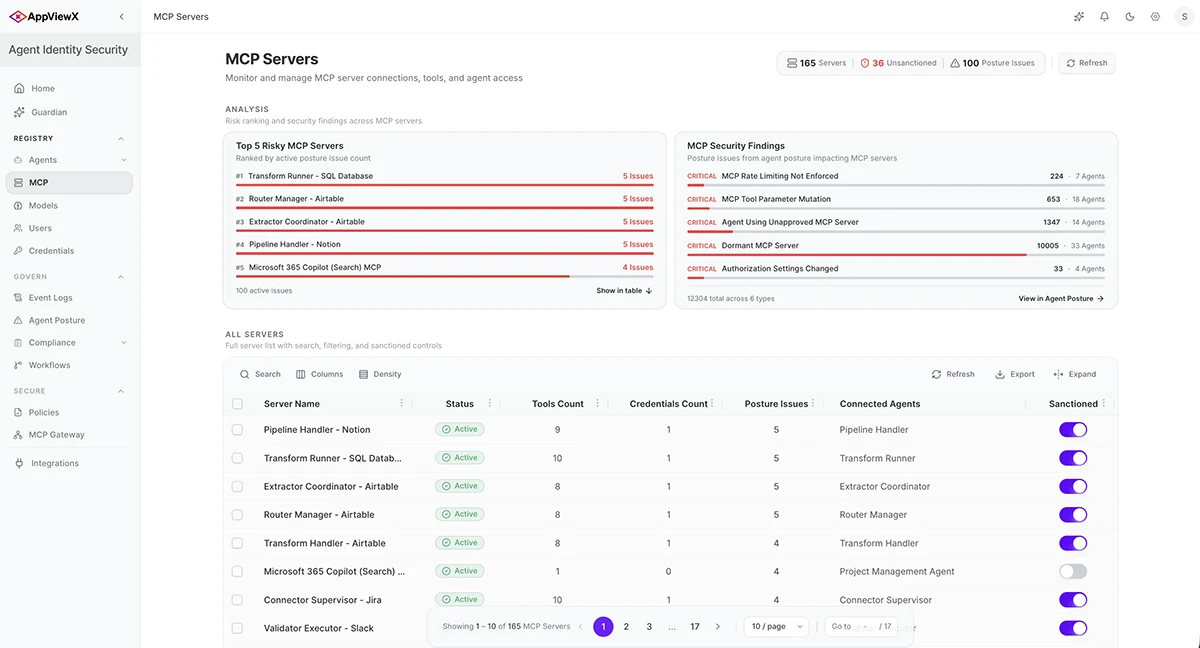
Discovering, monitoring, governing, and securing AI agents matters
The incidents have already started: stolen OAuth tokens at Salesloft/Drift, an Amazon Q prompt injection that wiped developer environments, and a Replit agent that deleted a production database after being told to stop. Gartner projects a quarter of enterprise breaches will involve AI agent abuse by 2028. Zero Trust requires more than visibility. Agent Identity Security continuously evaluates identity, context, and behavior to enforce adaptive access decisions before privileged actions occur.
Even with visibility, organizations need a defined process for introducing agents. An employee can build one on a low-code platform and connect it to a CRM, an integration that once required security review and now often bypasses it. Agent Identity Security adds lifecycle management workflows: agents route through review before production, and approved agents get guardrails automatically, giving those that touch sensitive systems defined, auditable boundaries.
Regulatory pressure is accelerating. NIST AI RMF, ISO/IEC 42001, and the EU AI Act all assume organizations know what agents are doing, who owns them, and what controls are in place. Most can’t answer those questions.
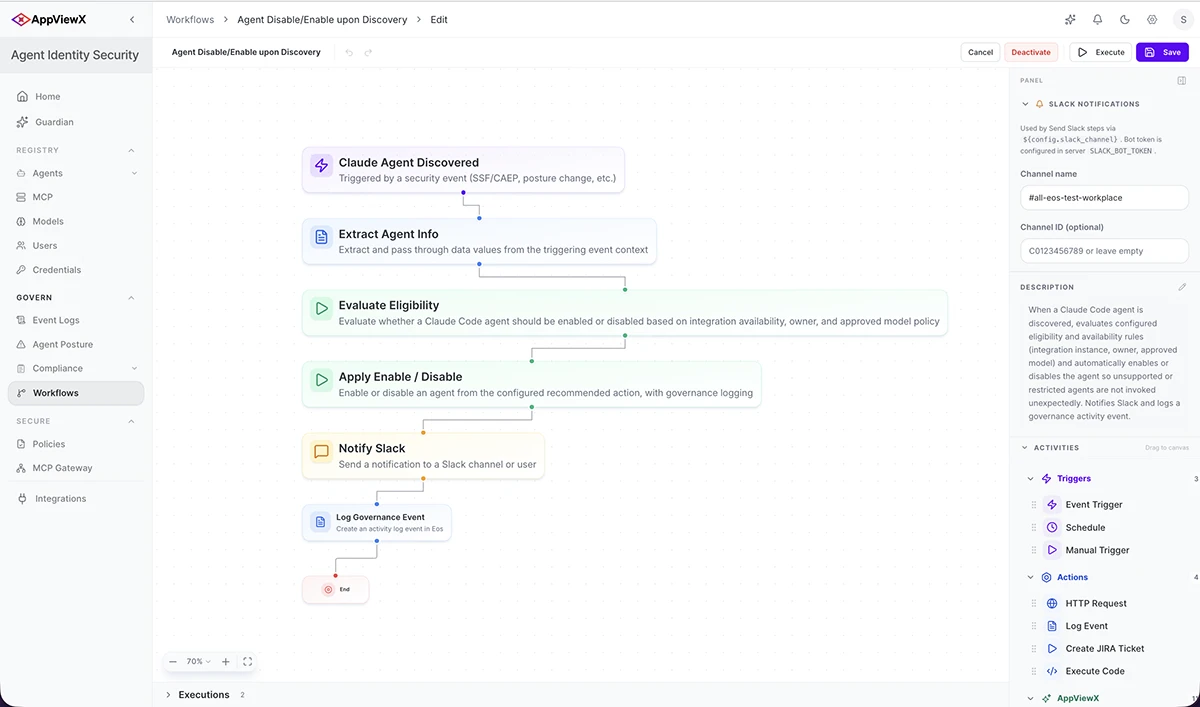
How Agent Identity Security works
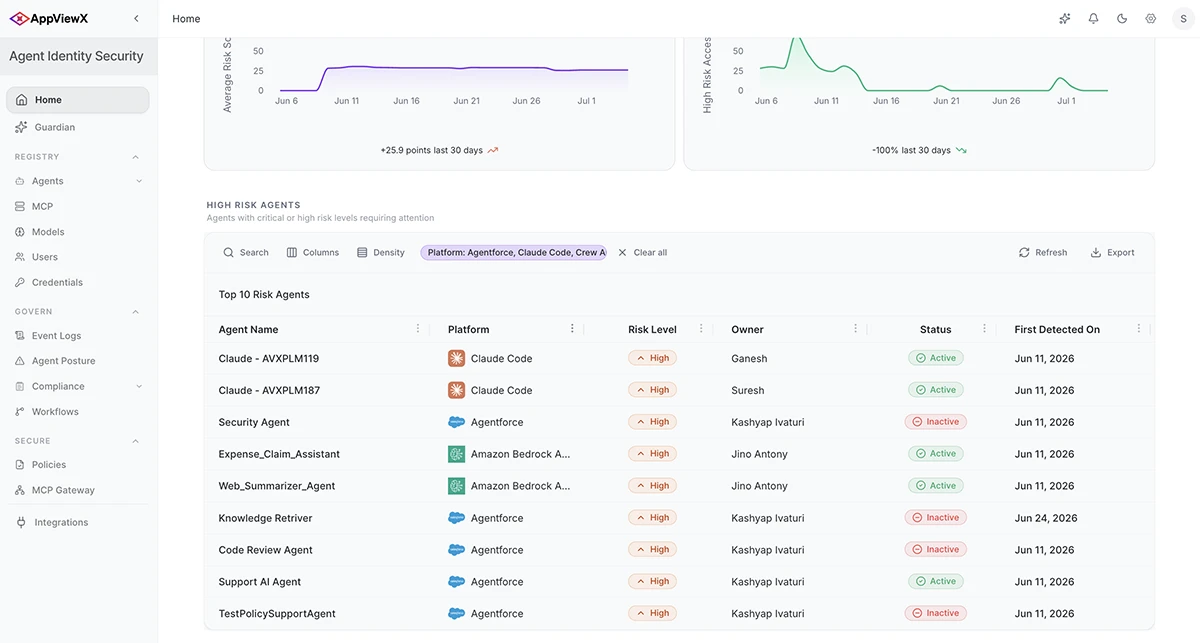
Organizations begin by connecting their AI agent platforms through the integration catalog. Our product then inventories every agent, including its identity, owner, connected MCP servers, LLM models, credentials, and runtime behavior. We call that the Agent Bill of Materials: a complete inventory of every agent, credential, certificate, cryptographic dependency, trust relationship, model, and connected service across your AI identity supply chain.
Teams can then review agent activity through event logs. Every event lands in a unified stream in OCSF format, flowing directly into existing SIEM environments without custom parsers. Beyond discovery, Agent Identity Security manages the complete lifecycle of agent identities, including provisioning, credential rotation, policy enforcement, and deprovisioning to eliminate orphaned privilege.
You then configure and enforce policies based on those insights. If an agent accesses a production database, you can restrict or manage that access. Meanwhile, Agent Identity Security continuously assesses agent posture, evaluating agents against configurable detectors covering ownership, credential hygiene, MCP server sanction status, model drift, system prompt changes, and more.
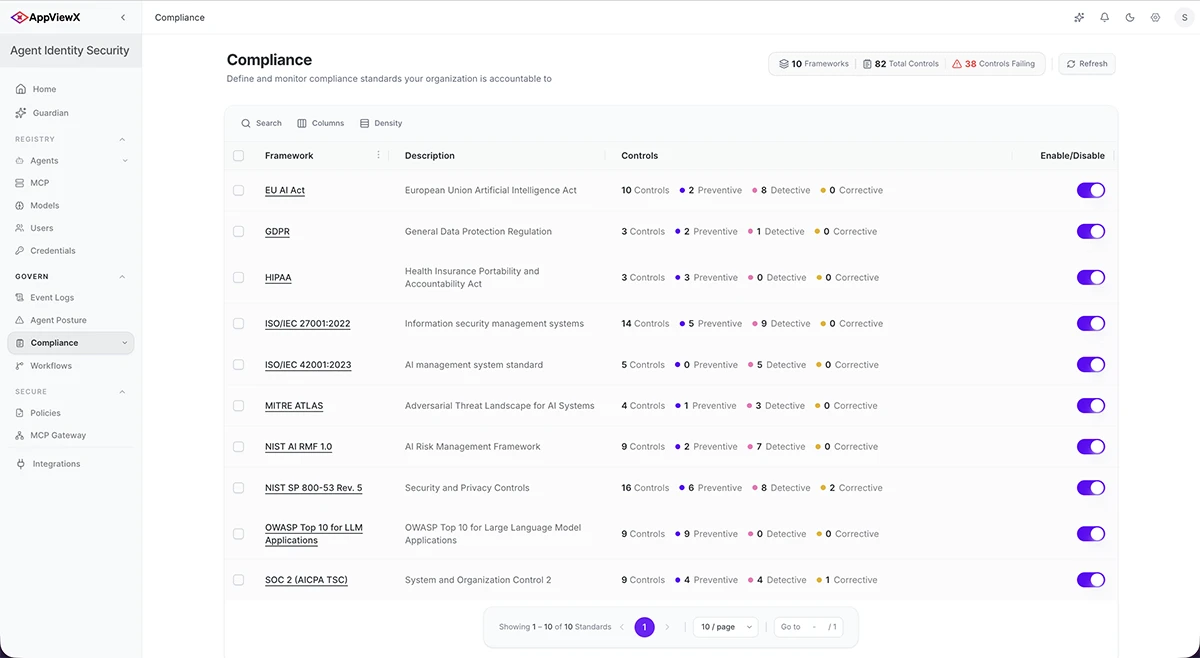
Detections map automatically to controls across SOC 2, NIST AI RMF, ISO 27001, the EU AI Act, OWASP Top 10 for LLM, and MITRE ATLAS, producing a compliance dashboard that shows satisfied and failing controls, and trending posture.
At the core is a configurable risk engine that drives insights system-wide. It evaluates agent identity, user access, data exposure, runtime behavior, connections to MCP servers and LLMs, and overall activity, scoring risk against your organization’s own risk profile. A low-risk agent reaching a low- sensitivity resource proceeds with minimal friction. The same agent behaving anomalously against a sensitive resource triggers an alert, a rate limit, or a block.
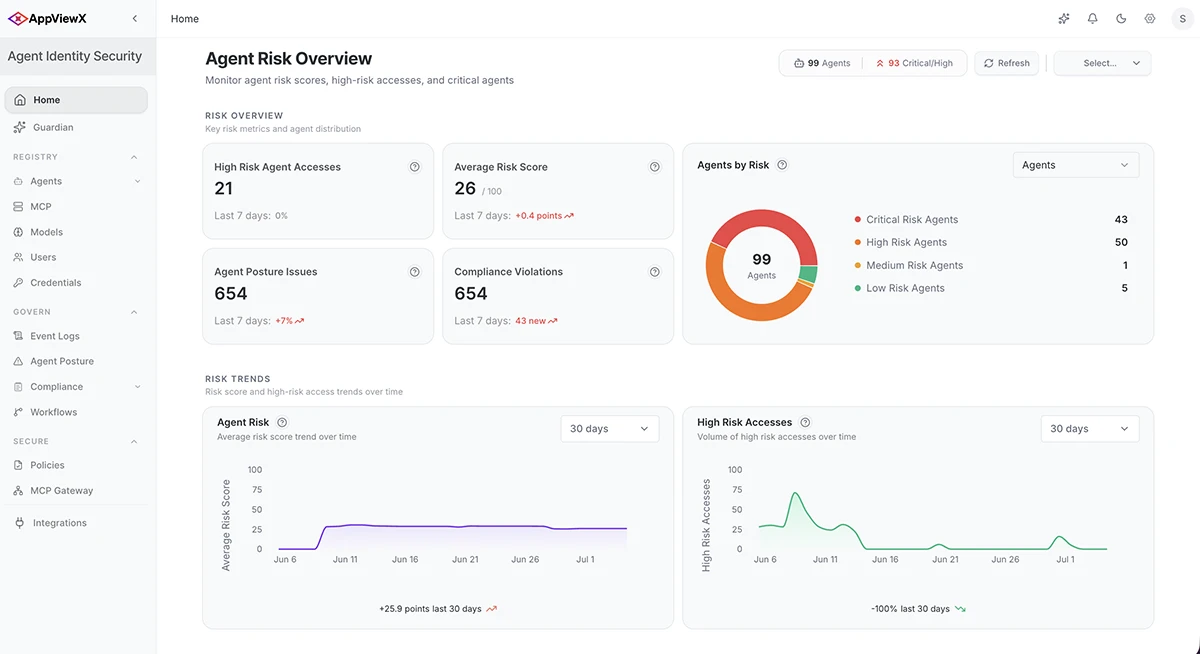
Agent Identity Security connects with existing security systems to act on identity provider events. Through the Shared Signals Framework (SSF) and CAEP, signals flow when employees leave or the IdP reports a compromised account. The result: dashboards that surface issues, recommendations, and posture insights.
Integrations and supported tools
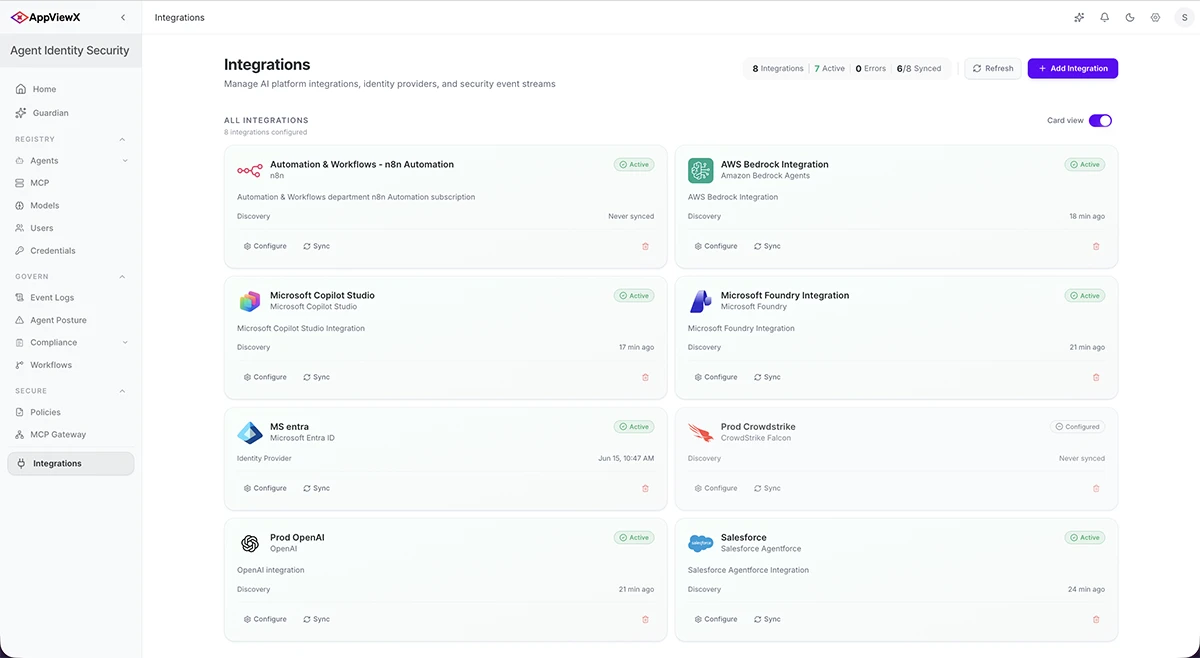
The integration catalog sits alongside your existing security stack, consuming signals, enriching
visibility, and publishing back into it.
AI agent platforms
- Major cloud vendors (AWS Bedrock, Microsoft Foundry, Google Gemini)
- Foundation model providers (OpenAI and Anthropic)
- Generative AI assistants and coding agents (ChatGPT, Claude Code and Cursor)
- SaaS agent platforms (Salesforce Agentforce, ServiceNow Now Assist, Microsoft Copilot
Studio) - Orchestration frameworks (CrewAI and custom platforms)
Security systems
- SIEM platforms via OCSF, CEF, LEEF (Splunk, DataDog, Sentinel)
- MDM and EDR solutions (JAMF, Intune, Crowdstrike)
Identity and credential management
- Enterprise identity providers (Microsoft Entra ID and Okta)
- Credential management and secrets vaults
Workflow and notifications
- ServiceNow, for approval-gated workflows
- Slack and Microsoft Teams, for real-time alerts and human-in-the-loop approvals
The catalog continues to expand to support new platforms and evolving technologies.
Closing the gap
Agents are already in your environment, governed or not. Agent Identity Security brings them under the same standards as every other identity before risk becomes incident, while extending visibility to cryptographic assets for post-quantum readiness.
That matters because agent identity is fundamentally a credential and trust problem, best solved from a machine identity and PKI foundation, not by retrofitting human IAM tools. Agent Identity Security brings agents into view, sets boundaries, and captures the upside without the risk.