- Pattern #1. Relying on Threat Data with Limited Coverage and Quality
- How Do You Break This Pattern?
- Pattern #2. Getting Threat Intelligence Too Late
- How Do You Break This Pattern?
- Pattern #3. The Distance Between Data and Action: Handling Threat Intelligence Manually
- How Do You Break This Pattern?
- Making Threat Intelligence Work for Your SOC

Disclosure: This article was provided by ANY.RUN. The information and analysis presented are based on their research and findings
It wouldn’t be much of an exaggeration to say that threat intelligence, which is supposed to help security teams detect threats earlier, can sometimes have the opposite effect on SOC efficiency.
Poorly selected or implemented threat intelligence sources can introduce new operational challenges and add friction to daily workflows.
Here are three reasons why your threat intelligence might be working against your SOC, and what you can do about it.
Pattern #1. Relying on Threat Data with Limited Coverage and Quality
With SIEM, EDR, and other security systems collecting telemetry, identifying suspicious activity, and helping analysts investigate potential threats, it’s important to remember that these tools primarily provide visibility into your own environment.
External visibility starts with intelligence about malicious infrastructure observed elsewhere. Without it, your SOC risks acting with limited visibility: a threat targets companies in another industry, but you only become aware of it when it reaches your organization.
To break this cycle, you can use external threat intelligence sources. But there’s another problem: their data may be outdated, low-quality, or overlap significantly with what you already have.
How Do You Break This Pattern?
Incorporate threat intelligence derived from real-world malware and phishing investigations across different industries. This helps expand visibility beyond your own environment and provides early warnings about malicious infrastructure observed elsewhere.
For example, ANY.RUN’s Interactive Sandbox can serve as a source of threat data, collecting malicious indicators from real-world malware and phishing analyses across a community of more than 16,000 organizations worldwide.
These indicators are delivered to your SIEM/SOAR/XDR and other systems through Threat Intelligence Feeds (TI Feeds), giving SOC teams access to malicious IP addresses, domains, and URLs observed across different industries.
With approximately 99% unique IOCs compared with other threat intelligence sources and a near-zero false positive rate, ANY.RUN TI Feeds help expand coverage without overwhelming analysts with duplicate or irrelevant data.
Pattern #2. Getting Threat Intelligence Too Late
Threat intelligence has a limited window of opportunity. The speed at which intelligence reaches security systems is an important factor in detection effectiveness.
An organization that receives information about malicious infrastructure earlier has a better opportunity to identify matching activity before an incident develops further. It’s all about how quickly new intelligence becomes available to your security stack.
How Do You Break This Pattern?
Continuously updated intelligence that can be delivered into detection systems with minimal delay is the only way to keep up with an ever-changing threat landscape.
ANY.RUN’s research illustrates why this matters. In a study of malicious indicators identified during Interactive Sandbox investigations, approximately 30% of unique malicious IOCs were already present in ANY.RUN TI Feeds before the corresponding investigations began.
This finding does not mean that 30% of all threats can be prevented automatically. Rather, it demonstrates that a meaningful portion of malicious infrastructure observed during investigations may already be known to a broader intelligence network.
When this information is delivered to an organization’s security controls, it creates opportunities to identify matching activity earlier. ANY.RUN TI Feeds support this approach by continuously collecting malicious indicators and instantly updating the feeds for early detection and broader visibility.
Pattern #3. The Distance Between Data and Action: Handling Threat Intelligence Manually
In many SOCs, threat intelligence is distributed across multiple tools and interfaces. Analysts may need to search external platforms, copy indicators between systems, compare results, and manually update detection rules.
Each step may take only a short time. Across hundreds or thousands of alerts, however, this work can consume a substantial share of SOC capacity.
It also creates inconsistencies. Different analysts may use different intelligence sources or follow different enrichment procedures, potentially leading to uneven prioritization and slower investigations.
How Do You Break This Pattern?
Through threat intelligence that integrates directly with existing security infrastructure and supports automated detection and investigation workflows.
ANY.RUN TI Feeds integrate with platforms such as Microsoft Sentinel, Microsoft Defender, OpenCTI, Elastic Security, Fortinet, Rapid7, and more through supported connectors, STIX/TAXII, and APIs.
Instead of requiring analysts to retrieve and check indicators manually, TI Feeds deliver malicious IP addresses, domains, and URLs directly into the systems they already use.
This allows SOC teams to build repeatable workflows where incoming indicators are automatically processed and used for threat matching, alert enrichment, and investigation prioritization, depending on the platform and its configuration.
For additional context, SOC teams can also use ANY.RUN Threat Intelligence Lookup that adds another layer of investigation, allowing analysts to enrich suspicious indicators with related threat context and hunt for connections to other malicious infrastructure.
ANY.RUN Threat Intelligence solutions connect threat data, automated detection, and deeper investigation, while allowing SOC teams to use the tools that fit their existing workflows.
Making Threat Intelligence Work for Your SOC
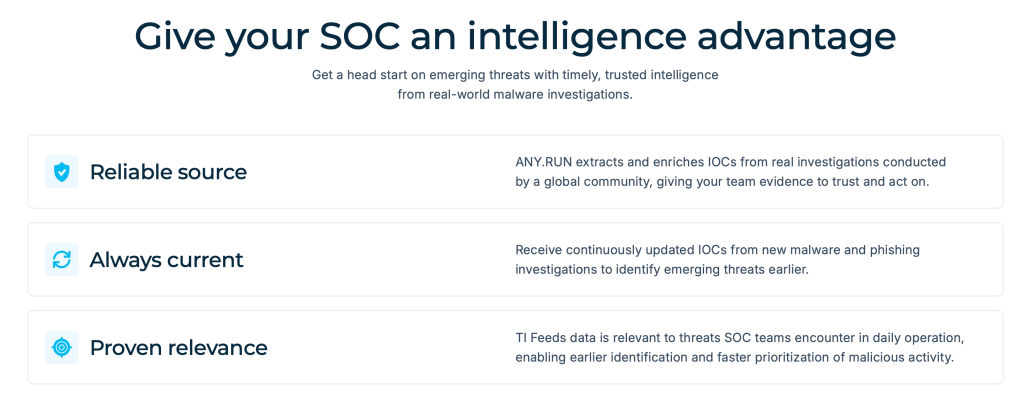
For SOC leaders, three priorities matter when choosing threat intelligence sources:
- Detection coverage: Look for intelligence sources that provide additional visibility into emerging threats, not just more of the same indicators.
- SOC capacity: Reduce manual intelligence handling through automated delivery and integration with existing workflows.
- ROI from existing investments: Make better use of SIEM, EDR, SOAR, and other security tools by supplying them with relevant, timely threat intelligence.
By combining independent threat intelligence with automated delivery into existing security systems, organizations can strengthen detection, preserve analyst capacity, and extract more value from their security investments.