Woolworths has gone live with an agentic AI-augmented version of its Olive chatbot to its 200,000-plus staff, and revealed how it is keeping the agentic responses grounded and accurate.
At Google Cloud Next ‘26 in Las Vegas, technology director of digital experiences Venky Erode Sivasubramaniyam provided the first live demonstration of the augmented Olive that Woolworths revealed it was working on back in January.
The retailer has signed on as an early user of Google’s Gemini Enterprise for Customer Experience product.
It has a broad relationship with Google covering cloud, data and AI infrastructure and services, with Gemini Enterprise the latest technology to find a home there.
Sivasubramaniyam introduced the onstage demonstration of the agentic-augmented Olive as “actually a live product that was launched [last] week for all of our staff within the group, which is about 200,000 people.”
Importantly, the demonstration sets some parameters around how Woolworths is enabling some of the features of the Gemini Enterprise for CX product.
Opening the Woolworths app, Sivasubramaniyam said that “one of the most common UX challenges that we are trying to solve in in retail world is how can we merge the search and the chat experiences together.”
Olive, in its staff-only preview form, represents the retailer’s first attempt at doing so.
Sivasubramaniyam used a text prompt asking Olive to “please add eggs, bread, and couple of other things for dinner tonight” to the shopping cart.
Olive responded by adding “free-range eggs, white bread, and chunky beef and vegetable soup to [the] cart for dinner” – but also offered some brand alternatives in the same response.
Sivasubramaniyam prompted the chatbot to provide organic options and asked it to swap out some non-organic products first added to the cart.
He then uploaded a photo of meal from his device gallery, and asked Olive for the recipe – which it recognised as spaghetti carbonara – and had it add the ingredients to that to the cart as well.
Sivasubramaniyam further prompted Olive to suggest cheaper alternatives to items already in the cart.
“People are going through a lot of cost of living crisis, so they want cheaper product options,” he said.
He further prompted Olive to show “how much [he] saved” by substituting the items.
The demonstration shows that an agentic-augmented Olive is very much the “meal planning assistant” that Woolworths suggested it would be, at least initially.
However, the Google product underpinning the agentic-augmented version of Olive is capable of more, notably of “consented actions” on customers’ behalf, such as adding items to a cart proactively and potentially buying them for the customer as well.
Sivasubramaniyam indicated that the retailer had broader ambitions for an agentic-powered Olive that could see it move into some of these spaces, particularly into pre-filling of a customer’s shopping cart.
“This is the first evolution, and customers are getting really used to these conversational journeys as we speak now,” he said.
“I think where we would like to take this is to start being more proactive in recommending baskets for customers and then starting a conversation from that proactive basket.
“Roughly – don’t quote me on the maths – but I believe about 80 percent of our groceries are repeat purchases, so if you actually show up a smart basket which you’ve repeatedly purchased each week and then start the [conversational] journey from there it’s a nudge to make that a lot easier. That’s one example.”
Sivasubramaniyam suggested that agentic capabilities could also help the retailer convert customers of its on-demand services – which are typically for only a few items delivered locally quickly – into bigger shops.
The agent, for example, could suggest making a past purchase but then try to push the customer “to a shopping journey”, with a larger basket size.
Agentic judges do the checking
Another important part of the US presentation is that it shows for the first time how Woolworths intends to keep the agentic suggestions on-track, accurate and trustworthy.
The retailer has built – “proprietarily”, Sivasubramaniyam said – eight “agentic judges” that sit in the background automatically vetting agentic-based responses before Olive surfaces them to the customer.
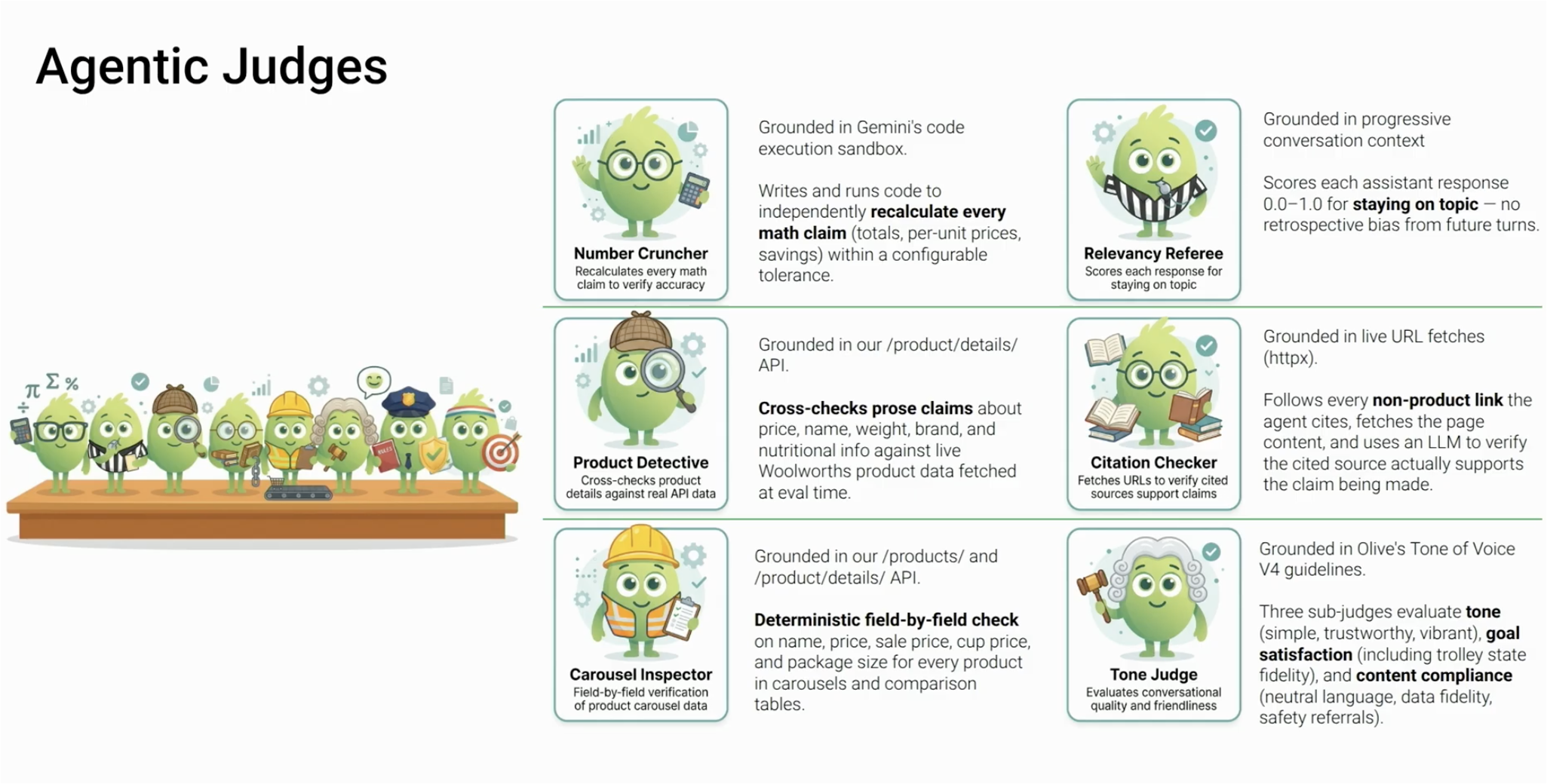
One of the judges is a “number cruncher” that “recalculates every math claim that we’ve got. for example, the best unit price, the price of the item, the ingredients in the item, or the serving size of a recipe,” Sivasubramaniyam said.
“It just makes sure that whatever the agent is providing, that it’s actually giving the right accurate information to our customers.”
A “product detective” judge aims to ensure that descriptions from the agent meet legal, food safety, and compliance requirements.
Another judge, called the “goal judge”, checks that the agent actually completed its mission without error.
“What it does is when you give it a mission, saying, ‘Build a basket within 20 bucks for a dinner tonight and it should include a roasted chicken’, if the agent accidentally comes back at $25, then the goal is not met and it would fail the use case and immediately alert us to the issue,” Sivasubramaniyam said.
“So, you need something like this bunch of agentic judges to actually implement products like agentic commerce or agentic solutions to scale across organisations and customers, particularly when you have a large audience.”