- Key Takeaways
- The Federal Application Estate Is Growing Where Inventory Can’t See
- Exploitation Now Starts Before the Patch
- Compliance Directives Converged at the Same Time
- What a Program Purpose-Built for This Moment Looks Like
- Qualys TotalAppSec: Application Security Inside the FedRAMP High Authorized Boundary
- Close the Exploitation Window
- See Every Mission-Critical Application and API
- Test the Way Adversaries Arrive
- Prioritize by Mission Risk
- Fix It, Then Prove It
- How TotalAppSec Maps to Federal Requirements
- Exposure Is the Variable You Own
- Frequently Asked Questions (FAQs)
- What does FedRAMP High authorization mean for Qualys TotalAppSec?
- How does TotalAppSec support CISA BOD 26-04?
- How does it map to NIST SP 800-228?
- Why is Moderate AppSec tooling a problem for High systems?
- Related

Key Takeaways
- Qualys TotalAppSec is now FedRAMP High Authorized on the Qualys Government Platform (FedRAMP Certified Class D, package FR2231052341).
- Federal AI use cases more than doubled in a year (3,611 use cases across 56 agencies), and most AI interactions are delivered through APIs; expanding an estate traditional IP-based inventory was never designed to measure.
- Mean time to exploit is now estimated at minus seven days. Agencies cannot out-patch an adversary who starts before disclosure.
- NIST SP 800-228 treats APIs as a distinct control surface. CISA BOD 26-04 requires risk-based remediation and application-layer asset tagging by December 7, 2026.
- TotalAppSec maintains 99.2%+ CISA KEV coverage with a 16-hour median from CVE disclosure to detection and produces ATO and ConMon evidence from within an authorized High boundary.
Whether you run a federal system, deliver a cloud service to an agency, integrate mission systems under contract, or support state and local programs that rely on federal data, you face the same two problems. First, the applications and APIs you’re accountable for are multiplying faster than you can inventory, test, and produce evidence for them. Second, whatever secures them must be authorized at the impact level of the systems it touches, and for High systems, the highest level, that leaves very few options.
If you’re pursuing or maintaining a High authorization, there’s a third problem: every control you cannot inherit is one more of the 400-plus you must document and defend yourself. The good news is that you no longer must choose between coverage and authorization.
Qualys TotalAppSec is now FedRAMP High authorized. This article covers what’s putting pressure on federal applications, what the 2026 directives require, and how TotalAppSec helps you meet them from inside a FedRAMP High boundary.
The Federal Application Estate Is Growing Where Inventory Can’t See
Federal AI adoption more than doubled in a year. The 2025 AI use case inventory from the Office of Management and Budget (OMB) counts 3,611 AI use cases across 56 agencies, up from 1,757 the year before. Of those, 445 are designated high-impact AI, which puts them under the minimum risk management practices in OMB M-25-21. AI coding assistants have cleared FedRAMP authorization, and the General Services Administration (GSA) is asking agencies to build Model Context Protocol (MCP) servers.
Every one of those is an application with an interface. Agents talk over APIs and run continuously. Gartner projects that 40 percent of enterprise applications will integrate task-specific AI agents by the end of 2026. Modernization adds more APIs. Of the ten critical legacy systems the Government Accountability Office (GAO) flagged in 2019, only three had been modernized by February 2025, and each of the remaining seven will become a set of services with APIs.
An inventory built on IP space doesn’t register any of this. A new agent endpoint on a server that’s already counted adds nothing to a host sweep, so the dashboard stays green while the attack surface underneath it grows.
Exploitation Now Starts Before the Patch
The same technology that is expanding the estate is also shrinking the time you have to defend it. Mandiant’s M-Trends 2026 puts mean time to exploit at an estimated negative seven days, down from 63 days in 2018. IBM X-Force found that public-facing applications are now the leading initial access vector, at 40 percent of incidents versus 32 percent for valid credentials, and that attacks starting this way rose 44 percent year over year. And 56 percent of the vulnerabilities it tracked needed no authentication to exploit.
Federal remediation clocks have long started when a flaw enters the KEV catalog, and a flaw only enters the catalog once it’s already being exploited. AI-enabled attackers require a different model.
Compliance Directives Converged at the Same Time
NIST SP 800-228, updated in March 2026, treats APIs as a control surface of their own. It calls for an inventory that includes shadow and zombie APIs, discovery at runtime, and reconciliation of declared specifications against live traffic. SP 800-204 covers the microservices architectures that modernized systems turn into, and SP 800-53 remains the baseline behind every authorization to operate (ATO) and continuous monitoring (ConMon) package.
CISA BOD 26-04, issued June 10, 2026, replaces flat patch deadlines with urgency calculated per vulnerability and per asset. The calculation uses four factors: exposure, KEV status, exploit automation, and technical impact. CISA supplies the last three. Exposure is yours to determine and defend, and applications must be tagged. The directive becomes operational on December 7, 2026. BOD 23-01 still requires discovery across the IP space every seven days, which finds the host but not the endpoints on it.
Zero trust called for the same capabilities as the NIST guidance and CISA directives above, years before 2026 put deadlines on them. CISA’s Zero Trust Maturity Model defines optimal application security testing as routine automated testing of deployed applications. The DoD strategy requires an application inventory, continual validation, and continuous authorization to operate.
FedRAMP made continuous detection and exploitability evaluation binding for cloud service providers. Its June 2026 notice calls monthly scanning insufficient and makes the Vulnerability Detection and Response (VDR) and Vulnerability Evaluation and Reporting (VER) rules mandatory on December 7, 2026. At High impact, that means detection at least daily, with reachability and exploitability assessed for each finding. After March 7, 2027, offerings that don’t comply lose their authorization, and with it the right to sell to government.
All four ask for the same things:
- know what you expose,
- test it continuously, and
- prove a flaw is exploitable, not just that it exists.
Most programs weren’t built for that. They still assume the attacker moves at human speed and rely on quarterly discovery, periodic scans, hand-recorded authentication scripts, spreadsheet API inventories, and remediation that waits on manual triage. An annual pen test won’t satisfy any of these directives. The problem is structural, and it’s time to fundamentally rethink how federal AppSec programs are built.

Qualys Webinar
What a Program Purpose-Built for This Moment Looks Like
The target is the same for everyone, and it maps directly to the three asks above:
- Know what you expose: Keep a current inventory of every web app and API, tagged by exposure and owner, so you can answer the exposure question on demand.
- Test it continuously: Test the way attackers arrive: authenticated, at runtime, and against authorization flaws that carry no CVE.
- Prove a flaw is exploitable: Show which findings are reachable and exploitable, work from a remediation order an assessor can follow, and generate evidence on a schedule, finding by finding.
And all of it has to run inside the authorization boundary. That’s where most teams have been stuck, because their tooling wasn’t authorized to run there. With Qualys TotalAppSec’s FedRAMP High authorization, it is.
Qualys TotalAppSec: Application Security Inside the FedRAMP High Authorized Boundary
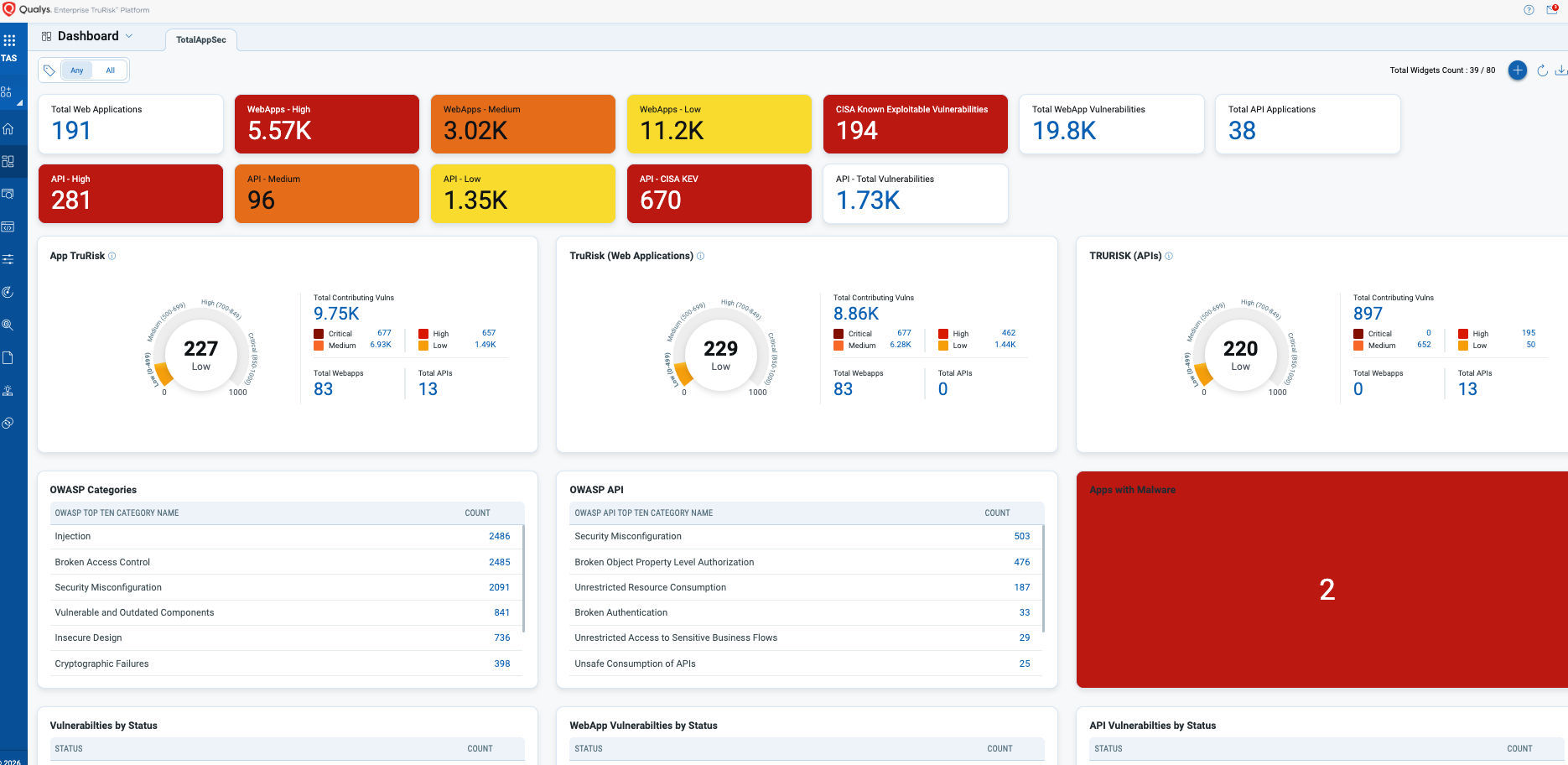
Qualys TotalAppSec is FedRAMP High authorized on the Qualys Government Platform, Class D under package FR2231052341. The platform aligns to more than 400 FedRAMP High controls, and organizations that build on it can inherit a substantial share of them. Instead of documenting every control alone, they start from a boundary an agency has already accepted. For agencies, providers and integrators alike, application security finally runs inside the same boundary as the systems it protects.
Close the Exploitation Window
TotalAppSec covers 99.2 percent or more of the CISA KEV catalog, the catalog BOD 26-04 is built on, with a 16-hour median from CVE disclosure to detection. You can’t out-patch an adversary who starts before disclosure. But you can know within hours which of your applications and APIs are affected and shrink what’s exposed.
See Every Mission-Critical Application and API
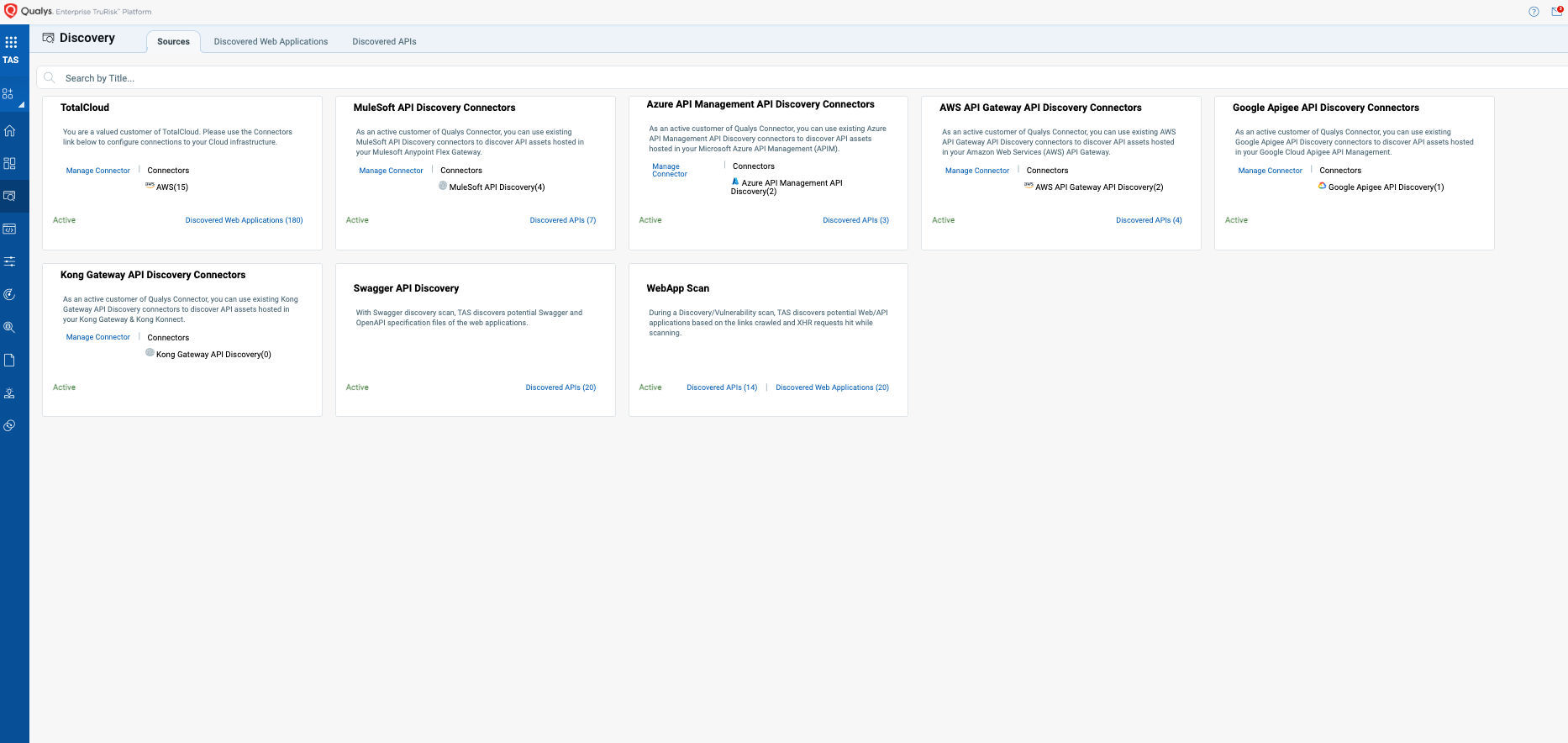
TotalAppSec continuously discovers known, unknown, forgotten, shadow and rogue web apps and APIs across cloud, on-premises and internet-facing environments and API gateways, including AI-serving endpoints and MCP servers. It finds APIs in crawled links and XMLHttpRequest (XHR) traffic, pulls from gateway and cloud connectors, and imports Swagger, Postman and Burp specifications. It reconciles every discovered endpoint against the declared inventory, so shadow and zombie APIs show up instead of staying hidden. That gives you the exposure determination BOD 26-04 asks for and the inventory SP 800-228 requires, kept current instead of assembled for an audit.
Test the Way Adversaries Arrive
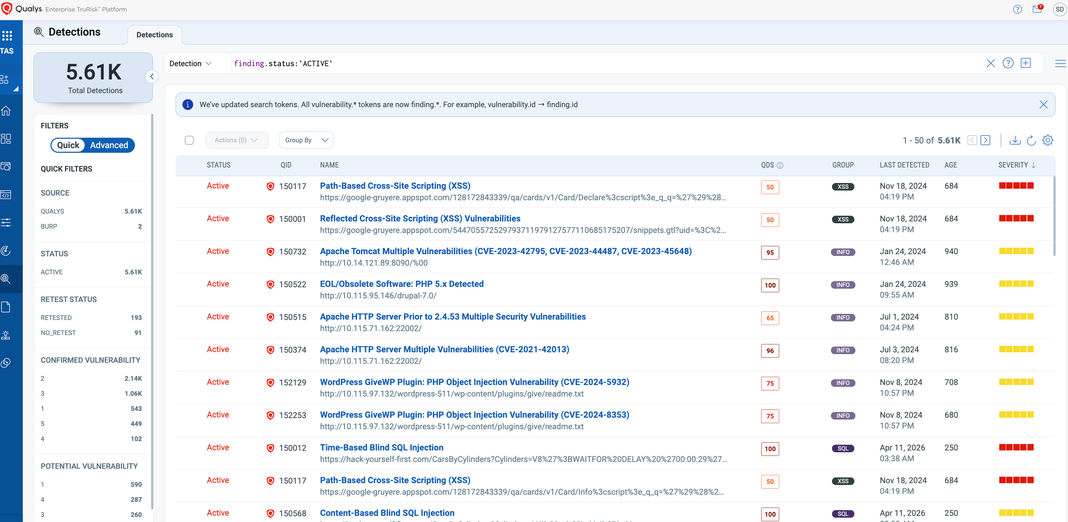
TotalAppSec tests running applications and APIs for OWASP Top 10 risks, sensitive-data exposure, and the authorization flaws behind real attacks: broken object level authorization (BOLA), broken function level authorization (BFLA), and broken user authentication (BUA). These flaws carry no CVE, so nothing in a CVE-based pipeline looks for them. TotalAppSec authenticates with OAuth 2.0, Proof Key for Code Exchange (PKCE), bearer tokens, and API keys, so it tests everything a legitimate caller can reach. Deep-learning detection catches zero-day web malware that has no existing signature. AI-Powered Scan Optimization cuts scan time by up to 50 percent without sacrificing accuracy, making the daily cadence FedRAMP expects at High achievable.
Prioritize by Mission Risk
Qualys TruRisk, the prioritization engine built into TotalAppSec, ranks findings by severity, exploitability, threat context, asset criticality, and business impact. It also pulls results from third-party AppSec tools and pen tests into the same queue. You get one defensible remediation order instead of several competing lists. The platform also produces the exploitability evaluation that FedRAMP’s VER rules call for, so you don’t have to argue it out in a spreadsheet.
Fix It, Then Prove It
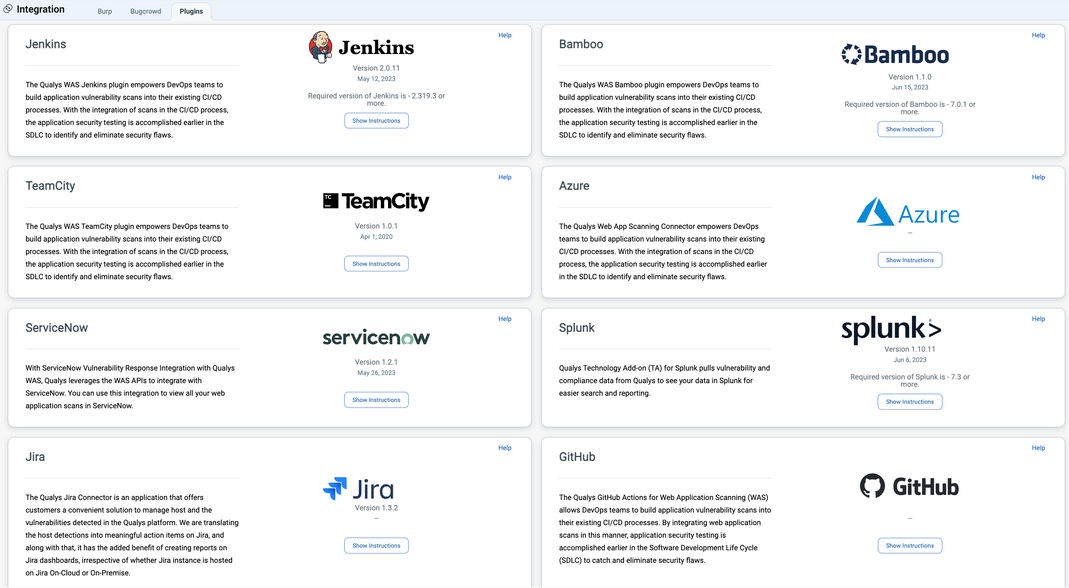
Findings route into CI/CD pipelines, Jira and ServiceNow, and TotalAppSec retests automatically after remediation. Centralized findings, scan evidence and retest results feed continuous monitoring and audit workflows. That produces evidence for SA-11, RA-5, SI-2, CM-8 and CA-7 on a schedule, from inside the authorized boundary. The output is what the 2026 rules ask for: reachability and exploitability for each finding, not a monthly CVE list rebuilt by hand.
For software you buy, the KEV tells you what to fix. For software you build, TotalAppSec tells you what matters. It doesn’t replace your API gateway or WAF. It finds what they can’t see.
How TotalAppSec Maps to Federal Requirements
| Capability | What it produces | Requirement it serves |
| Discovery of web apps, APIs and AI endpoints | Current inventory tagged by exposure and owner | BOD 26-04 exposure tagging; BOD 23-01; DoD ZT 3.1.1 |
| Gateway API discovery and spec reconciliation | Shadow and zombie APIs surfaced | NIST SP 800-228 REC-API-4.2, 4.3, 8 |
| Authenticated BOLA, BFLA and BUA testing | Proof that APIs enforce authorization | NIST SP 800-228 REC-API-12.3; CISA ZTMM 4.5 |
| Sensitive-data exposure detection | PII findings tied to app, endpoint and owner | NIST SP 800-228 REC-API-7 |
| 99.2%+ KEV coverage, 16-hour median | Fast detection of newly disclosed CVEs | BOD 26-04 KEV timelines |
| TruRisk prioritization | A defensible remediation order | NIST SP 800-53 SI-2; FedRAMP VER |
| Scheduled testing and reporting | Repeatable ATO and ConMon evidence | NIST SP 800-53 SA-11, RA-5, CM-8, CA-7; DoD ZT 3.5 |
| Reachability evidence inside the boundary | Per-finding reachability determinations | FedRAMP VER-EVA-EIR |
Exposure Is the Variable You Own
Everything here comes back to one question: what do you expose right now, across everything you’ve built and everything you’ve bought? A host inventory, an annual pen test and a gateway that sees only routed traffic can’t answer it at the layer where attacks start. On December 7, two of these frameworks will start asking.
The applications and APIs you can’t see aren’t exempt from attack. They’re just undefended.
Secure what your mission-critical application estate exposes before an attacker reaches it.
Frequently Asked Questions (FAQs)
What does FedRAMP High authorization mean for Qualys TotalAppSec?
TotalAppSec is FedRAMP High authorized on the Qualys Government Platform (FedRAMP Certified Class D, package FR2231052341), so agencies can use it against High-categorized systems without dropping to Moderate-only AppSec tooling.
How does TotalAppSec support CISA BOD 26-04?
It discovers and tags applications and APIs by exposure and owner, maintains 99.2%+ KEV coverage with a 16-hour median detection window, and produces reachability evidence required for risk-based remediation timelines beginning December 7, 2026.
How does it map to NIST SP 800-228?
It surfaces shadow and zombie APIs against declared inventories, tests authorization (BOLA, BFLA, broken authentication), and detects sensitive data exposure tied to application, endpoint, and owner.
Why is Moderate AppSec tooling a problem for High systems?
The moment commercial AppSec authorized only at FedRAMP Moderate touches a FIPS 199 High system, it becomes a control and authorization problem. High authorization removes that barrier.